Garage door springs do the heavy lifting. They store energy when the door closes and release it as the door opens, so the door feels light enough to lift by hand and the opener only needs to guide it. That stored energy is exactly why springs deserve respect. When one breaks, the door suddenly becomes dead weight, and when someone tries to replace a spring without the right tools, the results can be serious.
Merton Garage Door replaces broken and worn springs on residential doors, sizes new springs to the door’s actual weight, and rebalances the door so it runs smoothly. Here’s what you should know about the two main spring types, how they fail and what replacement involves.
Torsion springs vs. extension springs
Torsion springs
Mounted on a steel shaft above the door, usually on a center bracket. They twist as the door closes and unwind as it opens, turning cable drums at each end. Most newer residential doors use torsion springs.
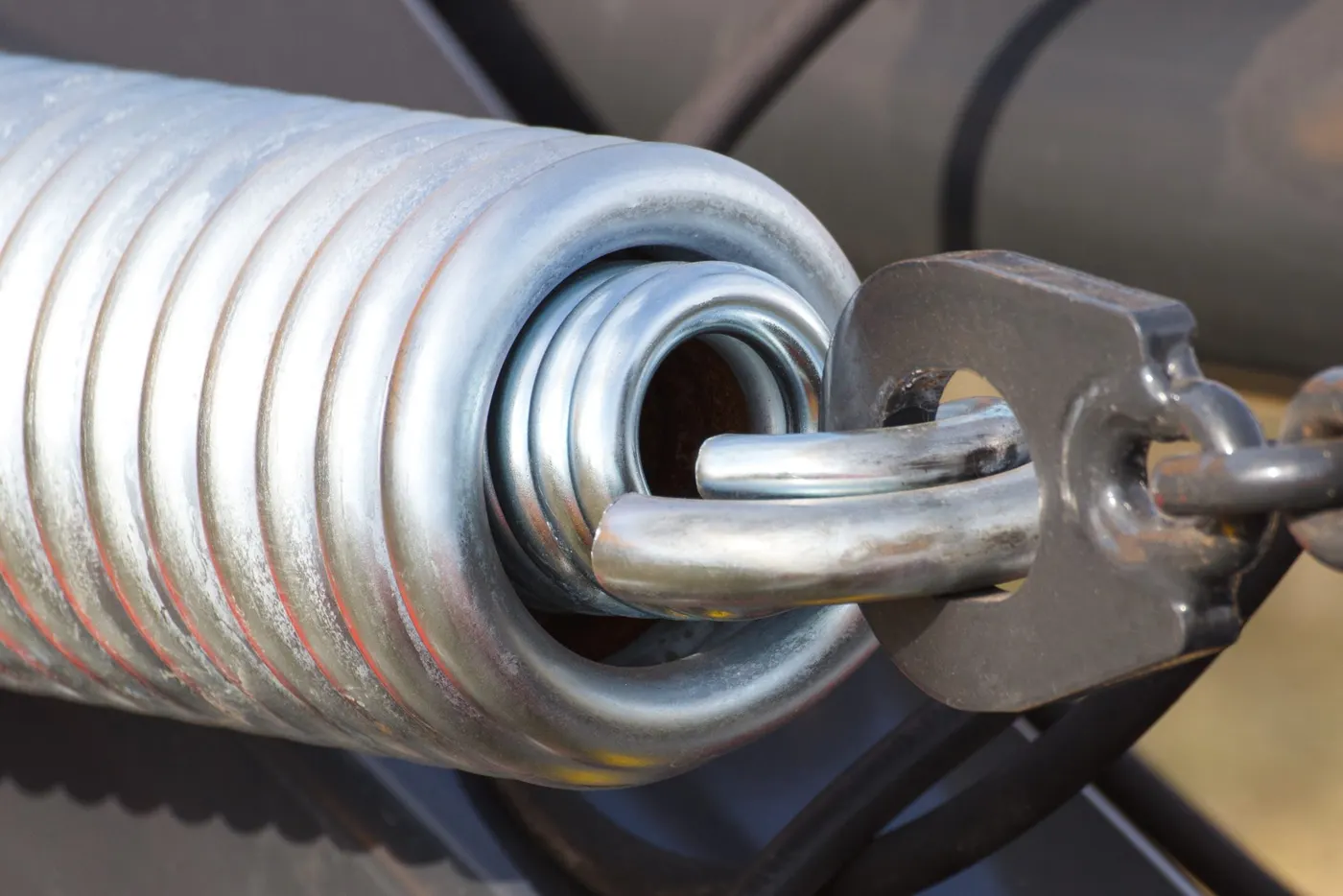
Extension springs
Run alongside the horizontal tracks on each side. They stretch as the door closes and contract as it opens, working through pulleys and cables. Common on older and lighter doors.
Both types are sized to the door. The wire thickness, coil diameter and length all affect how much lift a spring provides and how many cycles it’s likely to last. A heavier insulated door needs different springs than a lightweight single-layer door of the same size.
Extension spring systems should have safety containment cables running through each spring. If an extension spring breaks without one, pieces can be thrown across the garage. We check for these on every extension spring job.
Why springs break
Springs are rated by cycles—one opening and one closing. Standard-life springs are commonly rated around 10,000 cycles. That sounds like a lot, but a household that uses the garage as its main entrance can easily put four or more cycles on the door every day, which works out to several years, not decades.
Other factors shorten spring life:
- Rust — corrosion adds friction between coils and weakens the wire. Garages that see a lot of salt and moisture are more vulnerable.
- Cold temperatures — steel under stress becomes more prone to fracture when it’s cold, and many springs that were near the end of their life finally give out in winter.
- Wrong sizing — springs that are undersized for the door work harder and fatigue faster.
- Imbalance — on two-spring systems, if only one spring was replaced previously, the older one tends to fail soon after.
Signs of a broken or failing spring
- A loud bang from the garageOften described as sounding like a gunshot or something heavy falling.
- Visible gap in a torsion springA two-inch or larger separation in the coils above the door.
- Door won’t open or lifts a few inches and stopsThe opener can’t move the full weight and hits its force limit.
- Door feels extremely heavy by handA door that should feel light suddenly won’t budge.
- Door slams or drops quicklyWeak springs can’t control the descent.
- Crooked travelOn extension systems, one broken spring makes one side lift unevenly.
- Stretched or gapped extension springCoils that no longer close up tightly when the door is open.
- Loose or slack cablesA broken spring often leaves cables hanging loose.
What to do right now
Don’t keep pressing the opener button. Don’t try to lift the door with a car inside. If the door is open, don’t pull the emergency release—without spring support the door can come down fast. Keep children and pets out of the garage and call for service.
If the door is closed and the car is stuck inside, it’s tempting to try to muscle it up. Please don’t. A double door without spring support can be far heavier than it looks, and lifting it can damage the door, the track and your back.
How we replace springs
- Secure the doorWe make sure the door is fully closed and clamped so it can’t move during the work.
- Identify the right springsWe measure wire size, inside diameter and length, and consider the door’s weight and height, rather than simply copying whatever was there before.
- Release remaining tension safelyOn torsion systems, any intact spring is unwound with proper winding bars. On extension systems, the door is opened and secured so the springs are at rest.
- Install new springsOn two-spring systems, we generally replace both so they wear evenly. We also check bearings, center bracket, drums and cables while everything is apart.
- Tension and balanceSprings are wound or set to the correct tension, then the door is tested by hand to confirm it holds near the midpoint.
- Lubricate and testSprings get a light coating of suitable lubricant. We run the door under the opener and test the safety reversal.
Spring options worth asking about
When springs need replacing anyway, it’s a good moment to think about the next set. Higher-cycle springs are available for many doors; they use heavier wire and are designed to last more cycles, which makes sense for busy households. Some homeowners also switch from extension springs to a torsion system for smoother operation, though whether that’s practical depends on headroom and the door’s construction. We’ll lay out what’s possible for your door.
Why spring work belongs to professionals
Torsion springs are wound with steel bars inserted into a winding cone, one quarter-turn at a time, under considerable force. Using the wrong tool, like a screwdriver, or losing grip on a bar can let the spring unwind suddenly. Extension springs carry their own risks if they’re removed under tension or installed without containment cables.
Beyond the injury risk, the details matter. Springs that are slightly wrong for the door will make it drift, slam or overload the opener. Professional replacement gets you correctly sized springs, proper tension and a door that’s balanced at the end of the job.
How spring sizing works
Choosing a replacement spring isn’t a matter of grabbing whatever looks similar. A torsion spring’s lifting force comes from three measurements: the thickness of the wire, the inside diameter of the coil and the overall length. Change any one of them and the spring behaves differently. The door’s weight, its height and the size of the cable drums all feed into the calculation.
That’s why we don’t simply copy the old springs. Previous springs may have been the wrong size from the start, or the door may have gotten heavier over the years—a new layer of paint, a replaced section, added insulation or a new decorative overlay all add weight. Measuring the door and matching springs to it is how you end up with a door that holds its position and an opener that isn’t overworked.
On extension spring systems, springs are typically color-coded by the weight they’re rated to lift, and they need to match on both sides. Mismatched extension springs make the door lift unevenly and put extra stress on cables and pulleys.

Springs and Wisconsin cold
If you talk to anyone who works on garage doors in southeast Wisconsin, they’ll tell you spring calls pick up when the temperature drops. Cold steel is less forgiving, and springs that have been fatiguing quietly for years often give out on a frigid morning—usually right when you need to get to work.
Moisture adds to it. Garages in Merton see snowmelt dripping off cars, road salt carried in on tires, and humidity swings in spring and fall. Rust on spring coils accelerates wear. A light coat of garage-door lubricant on the springs a couple of times a year, and an inspection before winter, can help you replace springs on your schedule rather than theirs.
Garage door spring FAQs
Should both springs be replaced if only one broke?
On doors with two springs, we usually recommend replacing both. They’ve done the same number of cycles, so the second one is likely close behind, and new springs paired with an old one can make balancing harder.
Can I open my garage door with a broken spring?
We advise against it. Without spring support, the opener can be damaged trying to lift the full weight, and lifting by hand is difficult and risky. If you absolutely must get a car out, call us first to talk through the safest approach.
How long do garage door springs last?
It depends on the spring’s cycle rating and how often the door is used. Standard springs commonly rated around 10,000 cycles might last several years in a busy household and longer where the door is used less.
Why did my spring break in winter?
Springs fatigue over time, and cold temperatures make metal under stress more likely to fracture. A spring near the end of its life often fails on a cold day, even though the real cause was accumulated wear.
Can I adjust my springs to fix an unbalanced door?
Please don’t. Adjusting spring tension involves the same risks as replacing springs. If the door drifts up or down, or the opener struggles, call for a balance adjustment.